There is always a lot of discussion about Google, the lifeline for many entrepreneurs. Melissa Buijens of Zandcompleet drew a lot of attention at Webwinkel Vakdagen with her story about organic growth. 'Our Google budget has been zero for twelve years', she stated. This makes the platform company an - inspiring - exception.
Growth engine Google
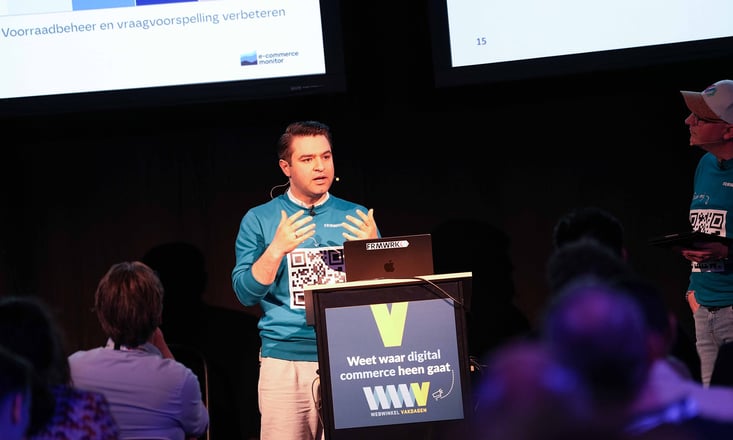
The reality is that most companies are working on search engine optimization on a daily basis. In his presentation at the exhibition, Mark van Hattum explained how Google has changed in recent years. He is CEO of the brand-new Follo, the name under which four digital marketing agencies have continued together. Only 1.97 percent of all searches still lead to results pages with only blue links, was one of the Google facts Van Hattum shared. Search engines also provide more and more direct answers, which impacts click-through rates. Meanwhile, customer journeys have become less and less linear and more dynamic ("Practice is more unruly than the theory of Google's See-Think-Do-Care model"), to the detriment of measurability. Then again, click rates are getting higher, quarter after quarter.
 I dare say Google knows more about your potential customer than anyone else."
- Mark van Hattum, CEO, Follo
Moving with Google
An important note is that overall search volume in Google is still rising. Van Hattum: "I dare say Google knows more about your potential customer than anyone else. His advice: look keenly at what Google is doing and move with it. What worked yesterday no longer does so today, he told the audience. For example, Product Boxes have become much more popular in a short time, which Van Hattum already touched on at the 2024 Webwinkel Vakdagen. For 82 percent of Follo customers' keywords, at least one Product Box now appears on the searcher's screen. Furthermore, according to him, search has become more conversational, with longer searches: 'These generate less traffic, but offer more added value.'
Investing in AI tracking and content
The next development that will have "enormous impact" are Google's AI Overviews, Van Hattum said. These are overviews that directly answer users' search queries. He expects them soon in Europe, which will further reduce click-through rates on paid ads. Web merchants would do well to invest in AI tracking and valuable content, according to Van Hattum, in order to be named in the AI interfaces of Google and others. "Companies write too much over-optimized crappy content now.

Enriching data in a data warehouse
To keep up in 2025, online retailers cannot do without a data warehouse, according to the Follo foreman. 'A no-brainer,' he says after his presentation. 'With it, you can pull in data and enrich it. Advanced AI works on the basis of LLM (language models, ed.), which works better as your data library becomes richer.' A data warehouse helps embrace AI, Van Hattum says advisable "from a Google perspective, but also beyond that. Finally, about the focus on AI, he says, "I think the short-term impact is overestimated and the long-term impact is underestimated, as is true for many new technologies.
Growing on marketplaces
Another key growth driver for many e-commerce companies is sales through marketplaces. Kamèr Aykaz can talk about it. He is head of marketplaces Europe at Versuni, the parent company of Philips Domestic Appliances since 2021. Among other things, his department sells coffee machines and airfryers in eight European countries through seven different platforms. In his presentation at Webwinkel Vakdagen, he named four tips for brand owners and e-commerce teams for selling on marketplaces.
Internal education
It all starts with the organization, Aykaz said. His department invested a lot in internal education, using storytelling, to let the entire company know why Versuni sells on marketplaces. Short and sweet: it allows the company to reach new shoppers, it allows it to offer its long-tail assortment on marketplaces, it provides relief in case of sell-outs elsewhere ("stand-by offer") and it contributes to profitability. 'We put the P&Ls (profit and loss statements, ed.) side by side to make that clear,' Aykaz said.
Getting the basics right
His second tip for marketplace vendors, based on lessons learned, is to get and keep the basics in good order. Operational stability is essential, which applies to the technical foundation and links, the supply chain and customer service. Clarity and transparency are also part of the basics according to Aykaz, they are prerequisites for success: 'Understand the platform, monitor, keep the lines of communication short and make adjustments,' he reminded visitors.
Less is more
Third tip, as the Dutch saying goes: fewer, bigger, better. Versuni has found that quality is more important than quantity in platform sales. 'Dare to make choices,' Aykaz said, 'for example, we stopped marketplace sales in Italy and the Czech Republic.' In addition to products and categories, Versuni looks at geography and platform specifications.
Product unit economics
Finally, the platform expert pointed out the importance of continuous optimization. 'For that, you need to create insight into profitability at the product level. At Versuni, we have spent the past year working on product unit economics on marketplaces. If you have those insights, then you can trigger actions based on them. Based on the contribution margin on marketplaces, for example, you can determine the maximum investments you make in media. We are now looking at how we can increase the return on marketplaces by offering volume discounts if people buy four vacuum cleaner bags, for example. Or how we can create bundles with package discounts, such as a free bag with a new vacuum cleaner.
Gut versus data
Knowledge is power, is also the message of the first E-commerce Monitor, which was presented at Webwinkel Vakdagen. To gain broader insight into the digital growth of Dutch e-commerce companies, Commerce Network, FRMWRK, Neople, Sendcloud and Spotler decided to present them with a number of questions. The research findings are linked to concrete advice in the E-commerce Monitor. One of the main conclusions is that data-driven companies grow faster than those that act a lot on intuition. "A lot of budget goes to gut feeling," is how FRMWRK's Thomas van Rooijen put it. This certainly applies to the smaller online retailers: 58 percent of the companies with a turnover of up to 1 million euros rely on the intuition and experience of the entrepreneur or management. Data and (financial) analyses are mentioned much less as a strategic decision source. The larger the webshop, the greater the role of internal and external data. These are crucial to reach customers in a targeted way, Spotler director Mark van den Berg said in an interview for the Webwinkel Vakdagen.
Drivers of growth
According to the makers of the E-commerce Monitor, fast-growing companies distinguish themselves from companies that are growing less rapidly in several areas: they more often take data-driven decisions based on predetermined goals and kpi's, they work on a scalable foundation, they make above-average use of external expertise and they set a dot on the horizon.
Hyperpersonalization through AI
Paul Kieviet, ceo of Xsarus, sees that many retail companies have of necessity shifted focus from revenue growth to profit growth. 'The current market is pretty tough,' he says at the Xsarus booth. 'To perform well these days, you need to be commercially and financially savvy. I see that many companies in their dealings are not sufficiently aware of the return below the line.' Certainly retail companies with a physical history struggle, he says, to properly identify the costs and revenues of digital activities. 'They wonder, for example, who should foot the bill internally for a new e-commerce platform. Sales, marketing, retail?' Different departments think from their own interests, Kieviet sees in practice with his digital commerce agency: 'Sales people will say that a Web store is cannibalizing, IT people will point to security. But you won't make it with those kinds of classic patterns. You have to realize today that you are an online business.' To grow, companies need to think across channels and departments. Not doing digital, but being digital, according to the agency director.
To grow, companies need to think channel- and department-transcending."
- Paul Kieviet, CEO, Xsarus
'Stop structuring data'
What does Kieviet expect future digital growth to come from? "You see that physical shopping experiences online can already be mimicked quite nicely these days, thanks to personalized websites and apps. Now, this still requires a lot of IT and companies are very busy structuring data. But I think hyperpersonalization through AI, which is where I think it's headed, is also possible with unstructured data. He throws caution to the wind: 'Don't waste your energy on validations and classifications, you can leave all that to AI. Let the language model decide.'
According to Kieviet, smart AI agents may well herald the end of CRM, ERP, CDP and PIM systems as we know them today: 'I see how busy companies are with bins of data cleaning, classifying and qualifying, but smart agents can skip that step, allowing us to say goodbye to those systems. It's a hypothesis huh, I too don't have a crystal ball.'
Ready to turn your growth ambition into reality? Make sure you’re there and get your free tickets.
Also read the report on the presentation by Anne de Korte of Dutchies. She named four growth hacks that made her popular company the best online store startup in the Netherlands.'Do you have a dream?Just go for it!'


