AI allows online retailers to do more with fewer people. For example, with a fraction of the labor, Bax Music has been creating ten times more content since the relaunch than before the online music store went bankrupt, Jochanan Bax told Webwinkel Vakdagen. He is growing 'his baby' in full force again. Besides AI, the emphasis is on omnichannel experience and own-brand products: the share of these doubled to well over 20 percent and it has to increase even more. At Bax, margins on private label are three times higher than those on branded products. Manufacturers are not always happy with the commitment to private label, but according to Bax this is a new reality they will have to get used to. And not just in the music industry: margin pressure and cost increases are changing the game.
 Margin pressure and cost increases are changing the game."
- Jochanan Bax, Bax Music
Fighting growing pains
The story of Jochanan Bax, who shifted his focus from sales growth to profitability, is not an isolated one. In 2026, costs must be offset by benefits. For healthy scalable growth, agility is a prerequisite, Lotte Dooper and Frank Tervoert made clear. They work at Notbranded, online high-growth retailer of affordable jewelry. The telling title of their presentation: 'Small team, big dreams: how Notbranded became big by staying small'. They outlined a problem they believe many e-commerce companies run into: additional staff, tools and channels quickly lead to loss of focus and speed and more complexity. Costs mount, which comes at the expense of profitability.
Ham question for Notbranded: what do we do in-house? And what do we outsource? The company knows how to "flexibly shift" according to changing needs. For example, inventory was outsourced and customer service was re-sourced, as reviews prompted. Notbranded created its own data warehouse, which partners can plug into. It is the foundation for data-driven marketing activities and onsite personalization. The jewelry retailer uses AI to enrich data and content - "the core of our business" - and for translations, enabling the company to provide more targeted and comprehensive help to customers in what is now already 28 countries.
To combat growing pains, a scale-up mindset, the right partners and continuous prioritization proved crucial for Notbranded. "We breathe the 80-20 rule," says Tervoert: "80 percent results in 20 percent of the time. Speed is our competitive advantage."
The profitable way up
Like Bax Music and Notbranded, Planet Happy benefits from a keen eye on costs, data-driven choices and AI. In 2012, Mark Ligteringen began selling purchased toys offline and online. He started on marketplaces and although there are often positive sounds about them, the toy business was struggling. You name it: V&D, Blokker, myToys and Babymarkt went under in succession. "Beware as a partner of marketplaces," Ligteringen shared an expensive lesson at the Webwinkel Vakdagen: it can end just like that. He went on to talk about peaks and valleys in corona time, with store closings and high online sales volumes: "I did not receive a corona bonus. Sales were growing, but profits were lagging."
On the verge of bankruptcy, the entrepreneur decided to rigorously change course. He started working with external inventory, which increased the assortment fivefold to 75,000 items - "now I've almost become a toy marketplace myself" - and cash flow improved. Today, thanks to ChatGPT, he can make do with one and a half programmers; a total of 30 instead of 100 people are still on the payroll. Through a "fully automated data flow," Ligteringen found the profitable way back up. He started collecting and enriching data from marketplaces like globe and Amazon using AI. The tool weighs costs against benefits, revealing the return per order. He built a new company around it: Attalos. "Profitability to the penny," is Ligteringen's promise, for marketplaces, by country and segment. He now breathes profit first.
From sphere to B2B
That willingness to change pays off, other entrepreneurial stories at the Webwinkel Vakdagen also showed. Like that of Stijn Madou of Camouflage Outdoor. He started selling wildlife cameras on sphere in 2020. It caught on. He saw and seized opportunities to sell his outdoor observation products to large international parties such as Walmart, MediaMarkt and Coolblue. That's how he made the move from bol to B2B, from local platform sales to global distribution. That move, according to Madou, is also for other ambitious platform sellers. He shared a detailed plan with seven steps to build an international retail brand: from preparation ("Set yourself up for a long ride") via positioning and lead generation to negotiating, closing ("Don't give a fuck about the outcome"), reselling and scaling. He larded each step with concrete examples and tips. The most important thing, according to Madou, is to sell on once the train is running. So: meet physically with retail partners at least once a year, make annual plans, make POS material available, set up promotions, request sales reports and pay surprise visits: "Mystery shopping provides insight into the buyers' experience, which makes you stronger in discussions.
Sales ready
Were Camouflage Outdoor a different kind of company, H1 changed hands for its next phase of growth. The Web development agency was acquired late last year by industry peer Emico Group, a specialist in Magento Web shops. Michel Willems, co-founder of H1, shared how his agency was made ready for sale . Or exit ready, to speak in the terms of Marktlink . "Start with the end goal in mind," is the acquisition consultancy's starting point, according to partner Erik Bretveld. "What is the situation, the intention, the goal of the sale?" Marktlink looked at whether H1 was ready for sale, something that goes far beyond the financial side of things, according to Bretveld. There came an indicative valuation and a plan of action, a "personal exit master plan." Experience expert Michels: "It's good to know what you can do now if you want to sell your business later. It was nice to see what companies in our sector are valued at, and the assessment of our value also gave us confidence." Both he and the buyer also present at the Jaarbeurs showed themselves happy with the takeover deal. A sale-ready process, which takes up to six months at Marktlink, generally delivers two things according to Bretveld: value optimization and deal certainty. "Consider that a sales process also takes nine to 12 months. The earlier you start, the more grip you have on the end result."
Buy-and-build strategy
You can be eaten, but you can eat yourself. That's what the Blue Raven Group, the holding company behind online drugstore Plein.nl, does. "We are growing fast in a competitive market," said Joas Garritsen. He is CCO of Plein.nl, named the Netherlands' best-performing e-commerce company late last year. "We manage to make a profit and thanks to a new investor we can make acquisitions. Then you have to think of parties whose positioning is either above Plein.nl, i.e. more specialized, or below it and aiming more for the masses." Earlier this year, Drogist.nl and a couple of associated web shops were acquired.
Blue Raven Group achieved sales of 150 million euros last year. The group now serves 2 million customers and there are more than half a million newsletter subscribers, according to Garritsen. The revenue goal is half a billion euros by 2030. "Our dream is to achieve that with one buyer, working two hours a day, " he said.
Supply chain agent
On Optiply' s side, Plein.nl last year succeeded in increasing the warehouse turnover rate by 20 percent, lifting product availability to 97 percent and the automation level to 91 percent. As a result, it now suffices for one person to place orders in two hours. With supplier links and dynamic pricing, Optiply contributes to the speed and profitability of Plein.nl. The AI-driven supply chain agent the company is now developing can make the procurement process of Plein and other web shops even faster and more efficient: "It knows your business, can act on your behalf, remembers and learns," outlined Optiply's Wiebe Konter. In the future, the agent can also proactively identify problems, activate or deactivate products, adjust schedules, complete purchase orders and provide strategic advice, is the idea. "It simulates the financial impact of decisions before you make them," says Konter.
Our supply chain agent simulates the financial impact of decisions before you make them."
- Wiebe Konter, Plein.nl
CRO for AI
Bax Shop, Notbranded, Planet Happy and Plein.nl showed that AI can help with content production, channel choices and inventory optimization. With it, online stores can make their operations faster, richer and more efficient. Felipe Wesbonk, consultant for SMEs, showed at Webwinkel Vakdagen how entrepreneurs can improve conversion in their shops with AI, thereby removing barriers not only for customers, but also for AI agents - a strongly growing new customer group.

AI search
The consumer, meanwhile, is also changing because of AI, came up in many presentations. AI search is huge and here to stay, was the main message of Stijn Bergmans of Follo. He made it clear that AI search, in which answers come from language models such as ChatGPT, is already almost as big as traditional search, if you include the AI Overviews that Google presents in its search engine. It's a fundamental change, according to Bergmans: "AI does the search work that people used to have to do themselves, the heavy lifting. In AI search, brands get less room to convince people than in traditional search, which shifts to the background. With that, existing metrics such as impressions and SEO positions lose relevance." AI search requires other KPIs, Bergmans said, such as AI visibility, LLM traffic and zero click brand impact. "GEO (Generative Engine Optimization) requires two tactics: attack, because people are increasingly searching LLMs, and defend: the AI also attacks traditional rankings." Even more reason to put in the work. Bergmans expects Web shops to put many more prominent FAQs on their pages this year to reach the otherwise searching customer: "Is this refrigerator quiet?" he cited an example. "Product specs can be a solution to a problem, for AI search you have to translate those specs into prompts."
For AI search, you need to translate specs into prompts"
- Stijn Bergmans, Follo
Agentic commerce as an additional channel
The question is whether and how long customers will continue to use Web stores to make purchases if language models allow them to do so within their platform. ChatGPT, however, quickly pulled the plug on its Instant Checkout again to focus on discovery and leave the transaction to others. It is tempting to think that agentic commerce won't fare so well with this, said Riverty's Alexander Scheibel at the Webwinkel Vakdagen: "As far as AI is concerned, we think in extremes," said the German responsible for the development of after-payment at Riverty. "But you don't give your child access to your bank account right away either. You give pocket money first." Confidence comes with time, he meant to say. "Consumers want to delegate, but not without control and the ability to intervene." He is convinced that agentic commerce will become established, "not as a replacement for existing online shopping, but as an additional channel." In this regard, Scheibel says "reversibility" is important: that consumers can control the buying assistant, albeit after the fact. "Agents factor that into their considerations. They steer not only by price, but also by reviews, delivery options, return policy and customer service. Terms and conditions and service are becoming as important as product data."
Terms and service are becoming as important as product data."
- Riverty's Alexander Scheibel, Riverty
Reliability and context
A similar message was delivered by Maite Zubiaurre, the CEO of globe. In her keynote presentation, she talked about how transparency and context have become more important recently; AI assistants and algorithms make assortments, prices and delivery times more visible than ever. In addition, customers are not looking for products, but a solution to a problem, such as: what shoes should I wear for that occasion? According to Spanish, it requires not only complete and clear product information, but also easy-to-read data for AI and richer content for diverse moments of use. To help sales partners with this, bol launched the Content Uploader, which allows entrepreneurs to add richer, readable, contextual data. Also presented around Webwinkel Vakdagen was Growth Reward, a new program through which bol rewards partners who perform reliably and invest in growth and customer experience. In addition, Zubiaurre announced the Shopper Agent, a store-wide AI assistant designed to make customers' lives easier. "We are building a new customer journey that responds to the challenges of our time."

We are building a new customer journey."
- Maite Zubiaurre, CEO, bol
From pre-purchase to post-purchase
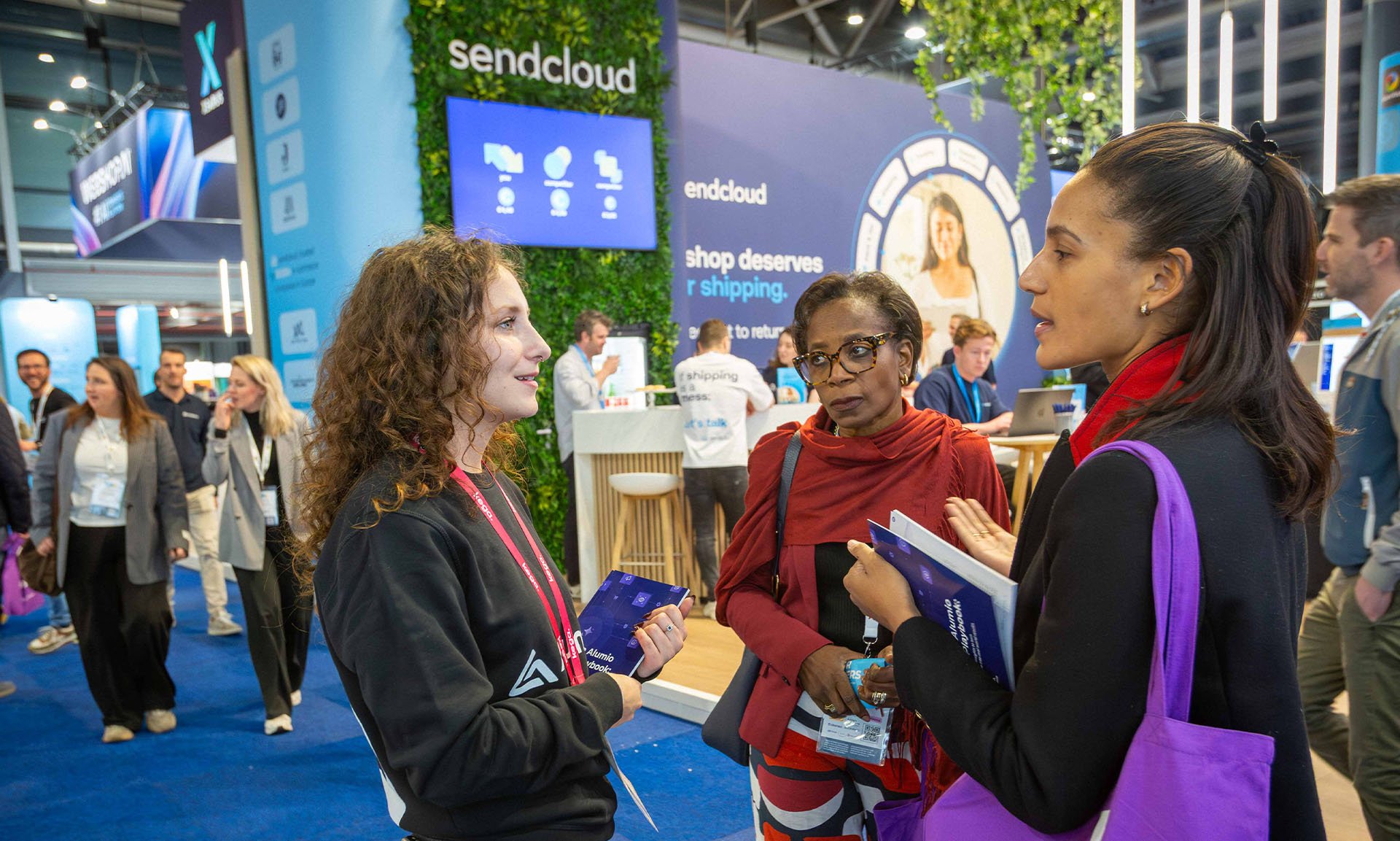
Like Scheibel (Riverty) and Zubiaurre (bol), Sendcloud 's Nick Buddingh reflected on the increased transparency in e-commerce. "The days of easy growth are over," he said. "Acquisition is expensive and more and more online stores are steering by margin. For better returns, you need loyal customers and for that you need to offer better service." According to Sendcloud, the focus is shifting from the pre- to the post-purchase phase. "You shouldn't think of that as the phase after a sale, but as crucial before the next sale. Improve and automate the "unhappy flow," is his advice, referring to an average of 10 percent of customer journeys in which something goes wrong. "That's where you really make a difference in loyalty: proactive, transparent and data-driven."
Among other things, Buddingh cited the E-commerce Monitor 2026, which showed that Web shops are increasingly focusing on profitability, customer loyalty and efficiency rather than rapid revenue growth.
Webshops are increasingly steering toward profitability, loyalty and efficiency."
- Nick Buddingh, Sendcloud
Healthy growth
AI offers new opportunities for online retailers to improve margins at a time when customers are behaving very differently. Healthy growth requires sharp choices and the adoption of new technological capabilities. But it is more important than ever not to lose sight of the customer.
Also read the interview with Monique Laheij, e-commerce manager of by-bar. She spoke at the Webwinkel Vakdagen: By-bar grows healthy with sustainable compass.


