While online consumer spending is stagnant, B2B e-commerce is booming. Business internet spending in Europe grew by an average of about 10 percent in recent years. And the forecasts are good.
Maximum customer control
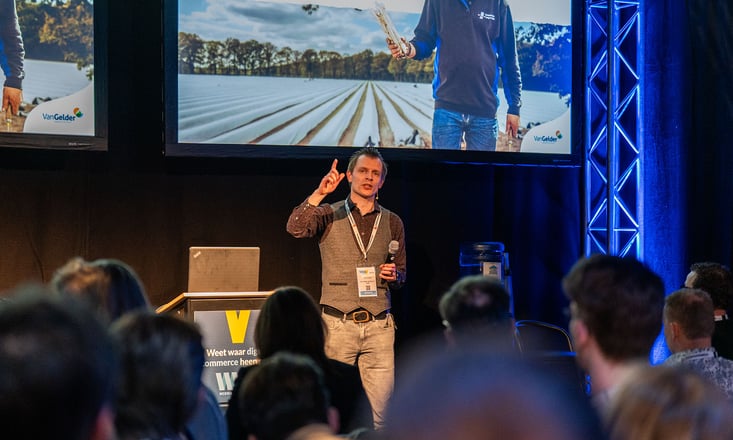
Van Gelder is a leading example in the field of B2B e-commerce. The company, which began as a grower and itinerant seller of Brussels sprouts, now receives 96 percent of its orders online. The fruit and vegetable wholesaler delivers mainly to the catering industry, from an automated warehouse with robots and shuttles in Ridderkerk. Marketing manager Robin Rietdijk told at Webwinkel Vakdagen about Van Gerlder's award-winning replatforming. He stressed the advantages of middleware and the importance of going live in phases; this offers the opportunity to solve problems quickly (starting with pioneering customers in the neighborhood) and to let the organization get used to the change. With the replatforming, Van Gelder decided to put the complete assortment live for all customers, but also to work with unique homepages before and after login.
Really think from the customer's point of view
Once logged in, customers see specific ranges, prices and delivery conditions 'without performance loss', says Rietdijk in his presentation. Orders are automatically broken down by delivery date and the ordering process is tailored to individual users, including automatically generated lists for repeat orders and search results based on previous orders. Order lists have also been made available offline, and customers can also manage the order list functionality themselves. “The customer in control” is what it’s all about at Van Gelder. 'Really think from the customer's perspective, who also orders from bol and Coolblue,' Rietdijk advises business online sellers. 'That means: look-and-feel neat, information up to date and maximum convenience.'
Full box promotions
Customer thinking also includes: data in order. Rietdijk: 'We offer so-called full box promotions: we point out to customers that they can save money by buying more products, for example a full box. We only do that if the customer wanted to order at least 80 percent of the products anyway and the price advantage is at least 5 percent. These promotions benefit both customers and ourselves.
From sales to advice online
'E-commerce is increasingly becoming a data game,' says Rogier Hosman at Youwe's booth. He is co-founder and CMO of the agency that has many B2B companies as clients. 'They want to be more than a commodity, because it's hard to compete with just pictures and prices. That's where many companies are hitting a ceiling right now. How can they distinguish themselves in a market with more and more competition and impatient customers?'
AI-trained expert
Hosman has an answer himself: 'AI can do a lot. When you talk about B2B, many people think of sales representatives driving around visiting customers, so to speak, so to speak to sell products. We've seen that sales are increasingly taking place online, now the consulting function is also moving to online - that's the next step. Future-proof B2B sellers offer the knowledge that a marketplace does not have, even online, and AI can help with that. Hosman takes De Heus, cattle feed vendor and customer of Youwe, as an example: 'De Heus offers added value if a farmer can get online feed advice anytime, anywhere in the world, tailored to his location and all other relevant circumstances at that moment. An AI-trained expert offers concrete solutions rather than high-level abstractions. The crux is to bring together all the existing knowledge of all the superior employees of such a company and make it available digitally. That way you can help customers in a unique way.

"Start building before it’s too late, even if you know that today’s AI solution won’t be tomorrow’s."
- Rogier Hosman, co-founder and CMO Youwe
Start building
The AI transition is unfolding faster than previous transitions, according to Hosman: "If you think about online and mobile, you are talking about 5 to 7 years, AI changes the whole world in a few years. Waiting to act makes no sense, he continues: 'Start building before you are too late, even if you know that today's AI solution is not tomorrow's. It's a matter of making data central, collecting and organizing it, and then drawing lessons to reinvent your business. Where to start? List the 10 biggest problems in your business and describe how you would solve them with the technology available to you today. Put a data scientist in there anyway.'
Don't forget strategy
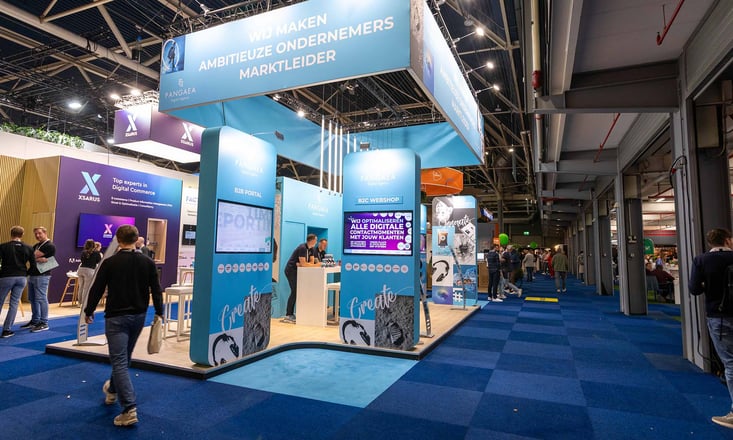
According to Bas Kroontje, founder and CEO of digital marketing agency Pangaea, for the time being, AI assistants with unique expert functions are still to come. 'AI is fantastic, but it's not moving as fast as I thought it would ten years ago myself,' he says at his company's booth. 'It's not making a real difference in terms of business yet. It will be some time before the technology has autonomous added value, for example in the field of inspiration.'
Underestimated child
In a presentation at Webwinkel Vakdagen, Kroontje explained how B2B companies can become market leaders in nine steps, or how they can "transform their platform from a standard portal to a strategic growth tool. In addition to marketing (three steps in Kroontje's model) and technology (also three steps), strategy (also three steps) is involved, often a neglected area, according to the seasoned expert: 'First and foremost, it's about where your distinctive power lies and what you yourself find important, the purpose and the why. But it's also about your BHAG (big hairy audacious goal, ed.), the big goal you are pursuing.'
From 1 to 4 euros
Third important strategic issue: how do you ensure that every euro you spend generates at least 4 euros in gross margin? Kroontje: "With such a business model, you can grow, experiment and keep investing when things get tough. Nowadays, companies talk a lot about ROAS (return on ad spend, ed.). I prefer to talk about POAS, even if it sounds a bit tongue-in-cheek.
D2C Opportunities on marketplaces
The word marketplaces has not yet been mentioned above. Yet platformization is big in the business market as well; more and more marketplaces are springing up, including from established marketplaces, and more and more B2B companies are joining as vendors.
International springboards
'B2B e-commerce is on the rise overall, but there was also a lot of room,' says Andreas Giese, founder and CEO of Dexport. 'Marketplaces give that growth an extra boost, and not only in B2B: they offer business sellers low-threshold opportunities to also sell their products directly to consumers, D2C for short. Abroad, they can do that themselves without being stuck with all kinds of chain arrangements. A service like Fulfilment by Amazon has accelerated that.'
AI as a growth catalyst
Giese, who helps e-commerce companies grow in Germany, among other countries, sees that AI is also working as a catalyst for the growth of B2B e-commerce: 'First of all, AI has made it much easier to create customized content, in addition, new possibilities have emerged for searching and finding your target audience. You can create automated segments based on identification capabilities and send out messages based on LinkedIn profile information, for example. From an entrepreneurial perspective, that is a dream scenario, from a privacy perspective it is less cheerful. According to Giese, the technology can provide leads on a silver platter. 'This will make the sales department redundant more than ever. But don't get me wrong, this is slippery ice, though.'
Composable commerce as a tool
Marco van Dorp told Webwinkel Vakdagen how Linde is using the power of AI in its search functionality. At least: in Western Europe. Linde is the world's largest industrial gas supplier, a company from 1879 with $33 billion in annual sales and 66,000 employees, which presents itself slightly differently in different regions.
AI-driven search functionality
The existing search functionality on Linde’s global platform fell short, Van Dorp and his colleagues at the Europe West region noted. 'We incorporated AI-driven search functionality locally as a composable solution,' the e-commerce foreman said in his presentation. 'You can describe composable commerce as building your e-commerce landscape with building blocks. It's like the game Jenga: replace a block without the tower falling over.' The new search function improves the customer experience, as Linde can now meet specific needs in a personalized way here. According to Van Dorp, the advantages of the composable architecture include flexibility, innovativeness, scalability and cost savings. "Your organization and your system landscape must be in order, as must internal support and the right skills," he says. He advises working from a step-by-step plan: "Composable commerce is a means, not an end. Think big, start small.
From product to customer
The streamlining of Lindes' search process should lead to better user experiences, personalized recommendations and ultimately incremental revenue growth. Van Dorp: 'It ties in with the shift in our focus: from product to customer.'
Ready to put your B2B customers at the center and discover how AI, composable commerce, and smart strategies can accelerate your growth? Visit Webwinkel Vakdagen 2026 and claim your free tickets.


